

Gallery
Historical photographs documenting the people, equipment and technology spaces that supported computing at Texas A&M throughout the decades.


In the late 1960s, students submitted their programs using punch cards, which were processed one at a time by large mainframe computers. During late-night shifts, some students looked for ways to move their work ahead in the queue, reflecting both the demand for computing access and the slower, sequential nature of early systems.

In the early days of campus computing, the Data Processing Center reflected the formal culture of the time.

A staff member manages rows of floor-to-ceiling magnetic tapes in the DPC. For decades, magnetic tapes served as the primary method for storing university records

A DPC staff member operates an IBM3350 disk storage system. This device provided high-capacity, direct-access storage for mainframe computing applications.
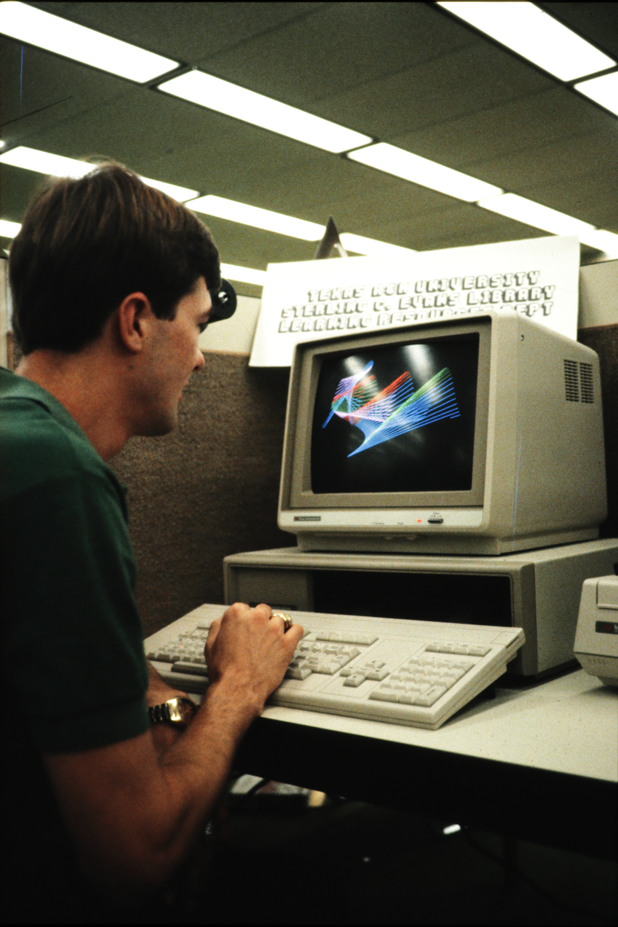
A student uses an IBM XT/AT or compatible computer with an Amdek monitor in the Learning Resources Center at Evans Library. Workstations like these provided students with access to digital learning resources.

Students prepare punch card decks using IBM 029 keypunch machines. Programmers and researchers entered data on punch cards, which were then processed in batches by the DPC.


The IBM 407 Accounting Machine and IBM 2401 Magnetic Tape Drives processed and stored large volumes of data, supporting Texas A&M's administrative and research computing needs during the early computing era.

The DYSTAC analog computer was used to perform complex mathematical calculations and engineering simulations, supporting research and technical analysis at Texas A&M.

An employee monitors system logs while coordinating mainframe operations over the telephone.
Last Modified: September 18, 2026